
Putting your ad out there is easy, while knowing whether it’s actually seen, noticed, and remembered is the real challenge.
In Out-of-Home (OOH) advertising, visibility alone doesn’t guarantee effectiveness. A billboard placed in a high-traffic area might generate exposure, but it doesn’t always translate into attention, engagement, or action. This raises a critical question for brands: how do you truly measure if your OOH campaign is working?
Today, OOH is evolving into one of the most measurable media channels, driven by data, technology, and advanced tracking capabilities. From audience movement data, brand lift, and attribution analysis, advertisers now have more tools than ever to evaluate performance. The challenge is no longer the lack of data, but understanding which metrics matter and how to interpret them to optimize campaign outcomes. This article will further explore what metrics you can measure from your OOH campaign and which tools are used to track them.
In OOH measurement, there are several key metrics brands can rely on. Reach focuses on actual audience scale by estimating how many unique individuals have seen your OOH campaign. Meanwhile, frequency captures how often those individuals are exposed to the ad. Together, these metrics form Gross Rating Points (GRPs), calculated as reach multiplied by frequency, providing a standardized view of total exposure relative to a target population. While these are considered traditional metrics, they remain highly relevant and widely used in evaluating offline media performance, including OOH (Cheong, de Gregorio, and Kim, 2010).
Beyond awareness, the next layer of measurement shifts toward action. This includes tracking engagement, such as interactions with the ad, which can be measured using tools like sensors, cameras, or other interactive touchpoints. From there, brands can evaluate conversion rates, including how many people proceed to make a purchase or use the advertised service.
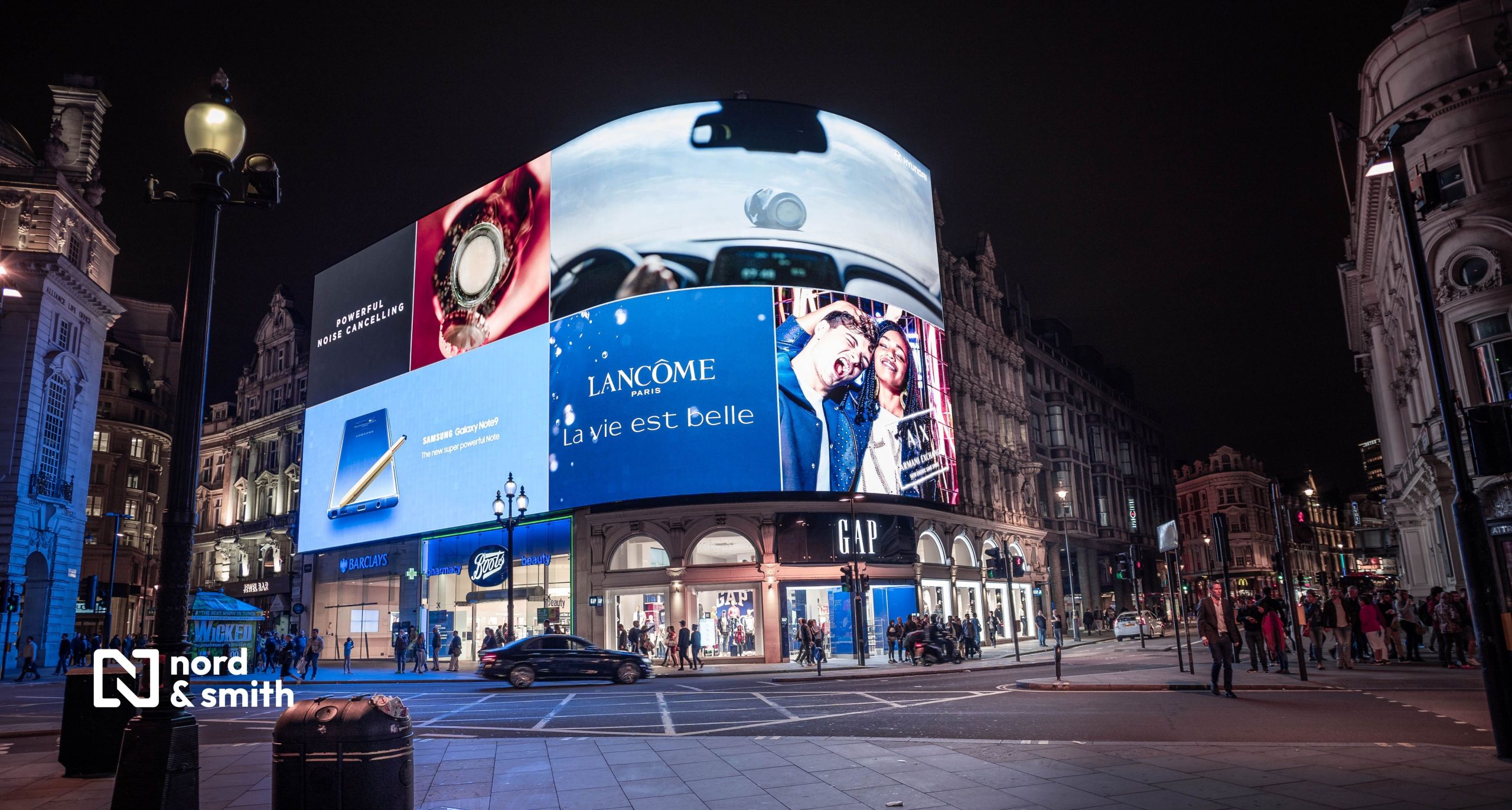
The evolution becomes even more evident with Digital Out-of-Home (DOOH). Unlike static OOH, which relies on modeled estimates, DOOH integrates technologies such as in-screen sensors, mobile data tracking, and geolocation to deliver more precise audience insights. Advertisers can now understand not just who is exposed to an ad, but also when they see it and what actions they take afterward, such as visiting a store or accessing a website. With hyperlocal targeting capabilities, DOOH also enables real-time audience flow analysis, making it possible to adapt and personalize messaging dynamically.
To maximize OOH campaign performance, measurement should start at the planning stage. At Nord & Smith, we apply Nord Scoring, an OOH visibility scoring system that evaluates factors such as viewing distance, average traffic speed, visibility quality, surrounding OOH density, share of dominance, and road-user perspective. Our reliable dashboard ensures that impressions and reach are not just theoretical estimates, but grounded in real visibility conditions. Beyond planning, Nord & Smith also supports brands through ongoing monitoring and comprehensive reporting, helping translate campaign delivery into clear, measurable outcomes.
Get your OOH campaign planned and executed with the right strategy with Nord & Smith, the data-driven OOH agency you can definitely trust.